

 Gift Cards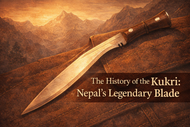
The History of the Kukri: Nepal's Legendary Blade
Posted by Silas on 16th Jul 2026
A kukri doesn't look like it should work as well as it does. The blade bends forward partway down its length, an angle that looks wrong to anyone raised on straight edged knives, until you swing one and feel exactly why that curve exists.
Where it comes from
The kukri traces its lineage back centuries in Nepal, likely descended from older curved blade traditions across South Asia, and it became inseparable from Nepalese identity as both a farm tool and a weapon of war long before the rest of the world took notice. That changed with the Gurkhas.
The blade that built a reputation
When Gurkha soldiers began serving in the British Indian Army in the early nineteenth century, they carried the kukri with them, and the weapon's reputation grew alongside theirs. Gurkha regiments earned a name for ferocity and discipline across two world wars and conflicts since, from the trenches of the Western Front to the Falklands, and the kukri became shorthand for that reputation. A soldier's tool became a symbol of a fighting tradition few armies could match.
Why the curve actually matters
The forward curve isn't decoration. It shifts the blade's weight and center of mass forward, which means a kukri delivers far more chopping power relative to its size than a straight blade of the same length, the geometry does the work that raw arm strength would otherwise have to supply. That's why a kukri clears brush, splits wood, and processes game with an efficiency that surprises people who've only ever handled straight edged knives.
More than one blade
Traditional kukris rarely traveled alone. Most came sheathed alongside two smaller companion blades, a karda for fine work and a chakmak for sharpening and striking flint, a complete field kit built around one primary tool. That completeness reflected the kukri's role as a working implement first, weapon second, even as its battlefield reputation eventually outpaced its everyday use.
What a real one looks like today
A genuine kukri earns that name through construction, not just shape. Since 1943 one maker has held the government contract to forge them for the Gurkha regiments of India, and that line runs through Windlass Steelcrafts still. The Genuine Gurkha Regimental Kukri is the standard issue pattern, forged the way the units actually carry it. The Officer's Kukri, with its buffalo horn grip and brass fittings, is the one issued to the men who lead them. The Assam Rifles Kukri carries a double fullered blade made to that regiment's own specification. And then there is the Gigantic Ceremonial Kukri, more than two and a half feet of steel, issued one to a regiment and kept for its sacred ceremonies.
Each of these looks and balances differently than a decorative import cut to a rough approximation of the silhouette. The distinction matters to anyone buying one, whether the interest is history, collecting, or simply owning a blade that's earned its reputation honestly. It sits alongside the broader tradition of Asian edged weapons this design comes out of, a tradition built on function long before it became collectible.
Two centuries after the Gurkhas carried it into the historical record, the kukri hasn't changed much. It never needed to.